

It’s the summer holiday season and I’m looking for simple pleasures, and simple explanations to complex causes.
A Campari Amalfi, for example. A simple, refreshing cocktail that makes me feel like I am living in this picture as soon as it hits my lips.

Or a John le Carré novel - a page turning spy thriller that is firmly middlebrow and doesn't tax my brain more than is necessary in the August heat.
You get the idea.
As the 14th Century Franciscan scholar and philosopher, William of Ockham posited:
the simplest explanation is usually the correct one.
His advice was to reduce, as far as possible, the number of assumptions used to explain complex phenomena, because layering assumption upon assumption can amplify small degrees of error.
This, in short, is Ockham's Razor.
And its definitely a very sharp single blade, not a quadruple bladed AI enabled shaving machine.
Ockham chooses a razor

I need this type of shaving tool right now because I’ve been struggling to wrap my head around two, big, hairy and very scary topics for quite some time now. I’ve gone down countless rabbit holes, done a lot of beard scratching and have now arrived at the conclusion that I might be “overthinking” things.
The first is falling global fertility and why people in many countries are having fewer children than they say they want to have.
The second, is the economics of left behind places and the fact that nearly every developed country is struggling to regenerate regions and cities that were once flourishing but have fallen on hard times. (With the connected trend that voters in these regions are turning to far right populist parties).
In the spirit of Ockham, I present my simple, but I hope not simplistic, explanations of these important socio-economic conundrums.
Baby bust
When surveyed, many women, especially the most educated, report a discrepancy between their intended family size (the number of children they wish to have) and the actual number of children they do have. One analysis estimates that this gap is leading to between 6 to 10 million “missing babies” per year globally.
This is making policymakers very nervous because there will be fewer young people of working (and tax paying) age to support an ageing population, and government finances are already under great strain in almost every developed country.
Time and again, rational explanations are given for why we are having fewer children:
Better access to contraception
Higher workforce participation, i.e. more women who are in part-time or full-time employment pursuing careers which is leading to an increase in the average age of first-time mothers and a shorter overall fertility window for having multiple children.
Practical barriers like a lack of accessible and affordable childcare, and a general increase in the cost of living which makes it more financially challenging to support larger families.
Climate anxiety, or the idea that it's unethical to bring a child into a burning, flooding world on the brink of ecological (and social) collapse.
Earlier this year I wrote a piece looking at intensive parenting practices, and considered if this explains why so many parents report feeling perpetually exhausted and burned out.

My slowly dawning sense back then was that many prospective parents look at their frazzled friends and disheveled colleagues with children and think, 'fuck living that life, no thanks'.
As Janan Ganesh points out, the way fertility choice questions are framed is very important and might provide a simple explanation for our global fertility undershoot:
asking people whether they want more children is close to pointless. The question is whether they want them above other things. Stated desires are not useful information unless ranked. I want to be more successful, but not as much as I want to sleep until 10am. People want larger families, but not as much as they want leisure and surplus cash.
This is where Ockham's razor is at its sharpest and most incisive.
The preferences of my generation (Millennials) have clearly shifted from those of previous generations.
Many of us would rather achieve our personal and career goals before having children, and because this coincides with women's peak childbearing years, having children is deferred and fewer children are born.
Listen also to the linguistic shift: fewer people are referring to themselves as 'childless' — a traditionally pejorative term which suggests an inability to conceive — and more people are becoming 'childfree' — a more considered and liberating sounding choice. As Ganesh sums up :
the evidence suggests that once people are rich and free enough to choose, they choose individualism. Many do so with a pang, of course. They really do want more kids. But not as much as they want to live in the city of their choice or hold out for a relationship that is fun and not just stable.
Left behind places
The politics of neglect explains the geography of discontent experienced by people in places like Görlitz (Germany), Salizzole (Italy), the Vosges department (France), Boston and many other parts of the UK, Chegas (Portugal) much of eastern Belgium and the American rust belt. In these places, and many more, voters feel like they have been abandoned by politicians who don’t look or sound like them, and don’t really care about their futures.
This is the emotional part of it.
The economic part is that many of these places have also seen an underinvestment in social infrastructure like good transport links, schools, hospitals and other public services.
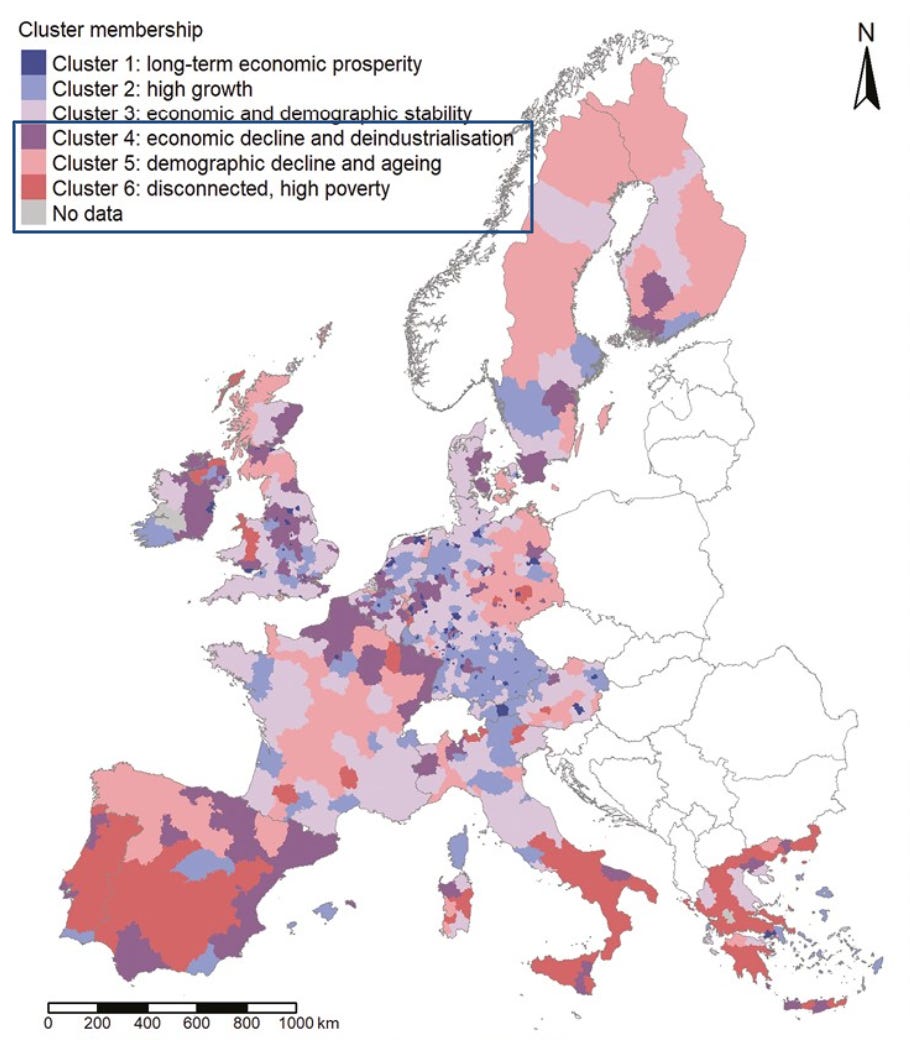
They are also connected by the fact that they once had thriving industries, such as coal mining, textile manufacturing and steel production. However, globalisation has made these industries uncompetitive, resulting in job losses that have not been offset by new employment opportunities. The message to the young and ambitious in these places is clear:
there is nothing here for you, get out as soon as you can!
For those who remain, mutinying against established centre-right and centre-left parties is a low-risk strategy because they have nothing left to lose. This explains why all of these areas have swung towards hard-right, populist parties.
In his latest book Left Behind: A New Economics for Neglected Places, the Oxford economist Paul Collier explains how this happens in a few key sentences (you can thank me later for saving you the effort of reading the full 304 pages):
Social psychology has provided us with a credible account of why capitalism can generate both thriving communities of work and ugly hierarchies of humiliation. It also explains why as a place starts to decline the local community tends to fragment as people set about blaming each other for the failure.
[...]
A short step beyond mutual blame is self-blame : people internalise the notion that they have been overtaken because they or the place where they live are in some way inadequate.
[...]
Places that successive governments have failed to level up, where obesity, inactivity, addiction, depression and hopelessness caused by lack of opportunity, can become a mutually reinforcing spiral.
The emerging, evidence-based consensus is that the hierarchy of factors determining life outcomes, and the extent to which someone can be considered “lucky” at birth, is as follows:
Where you are born (place). Metropolitan areas beat rural backwaters.
To whom (i.e. your parents' level of education). Parents with university degrees bestow a big educational advantage to their children.
Your gender. P stands both for penis and privilege.
Your race. (In the UK and Western Europe the effect of being non-white is smaller than in the USA).
As some of you may have noticed, however, William of Ockham was more interested in explaining phenomena than formulating solutions.
So I’ll take the liberty to offer up a few (simple) solutions.
Clearly, levelling up requires long-term commitment to regeneration, dedicated local leadership, and a restoration of pride in specific places — something that the UK in particular has failed to achieve.
If that sounds oversimplified, there is an even simpler alternative, which is to just tell people in deprived places “get on their bike” and go somewhere else, like an already affluent city offering more attractive job prospects.
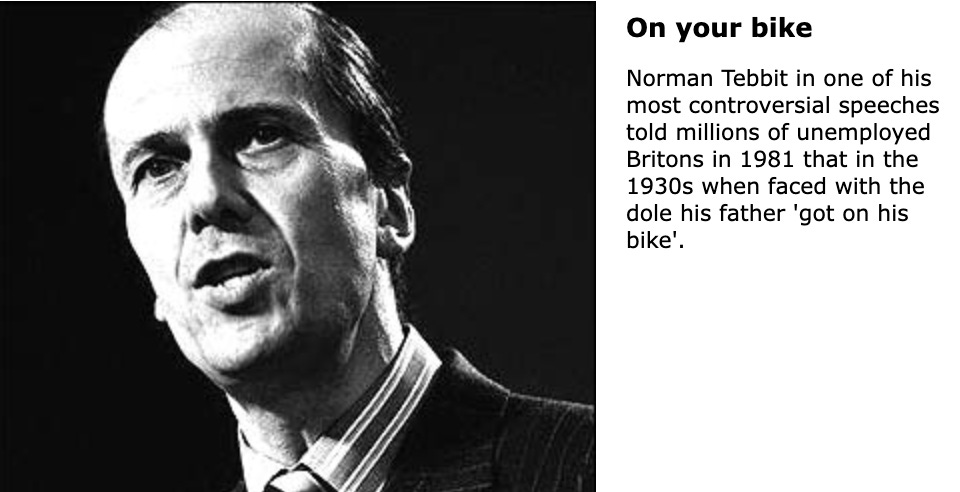
But creating a society that is far more geographically mobile, where people can choose their own communities instead of being “stuck” where they were born, is not as simple as it seems.
To use David Goodhart's useful formulation, there are more 'somewheres' — people who are rooted to the place where they grew up by social bonds and identity — than 'anywheres' — liberals who feel free to roam — in the world.
Which presents an impediment for thinkers like Yoni Appelbaum, who argue that movement, presumably by means other than just a bicycle, is what enables people to escape economic stagnation :
The sharp decline in geographic mobility is the single most important social change of the past half century
[...]
many Americans are stranded in communities with flat or declining prospects, and lack the practical ability to move across the tracks, the state, or the country—to choose where they want to live. Those who do move are typically heading not to the places where opportunities are abundant, but to those where housing is cheap. Only the affluent and well educated are exempt from this situation; the freedom to choose one’s city or community has become a privilege of class.
To summarise, Appelbaum's proposition is to build more affordable housing by reforming restrictive zoning laws in major economic hubs where demand outstrips supply. His key assumption is that people living in areas with fewer economic opportunities will get on their bike.
I can’t help wondering, if Ockham would have considered this to be the simpler or more complex solution to levelling-up? In any case, I hope he would have said, "Stop overthinking it and just do something for God's sake".
Bang on Max, we see this trap all the time, the danger of not understanding the gap between intent and decision making has sent many an innovator down the wrong path! Classic ‘Mom test’ territory.
Hi Max, one issue that those who can ( I.e. higher abilities) are more likely to leave deprived areas. See this study https://research.vu.nl/ws/portalfiles/portal/127420931/Genetic_correlates_of_social_stratification_in_Great_Britain.pdf
This not to blame the victims.
There is more selection that is taking place than people give credit. Just like voluntary immigrants are usually have higher abilities, on average, than the host population. It seems like a “natural threat” that is sensed….